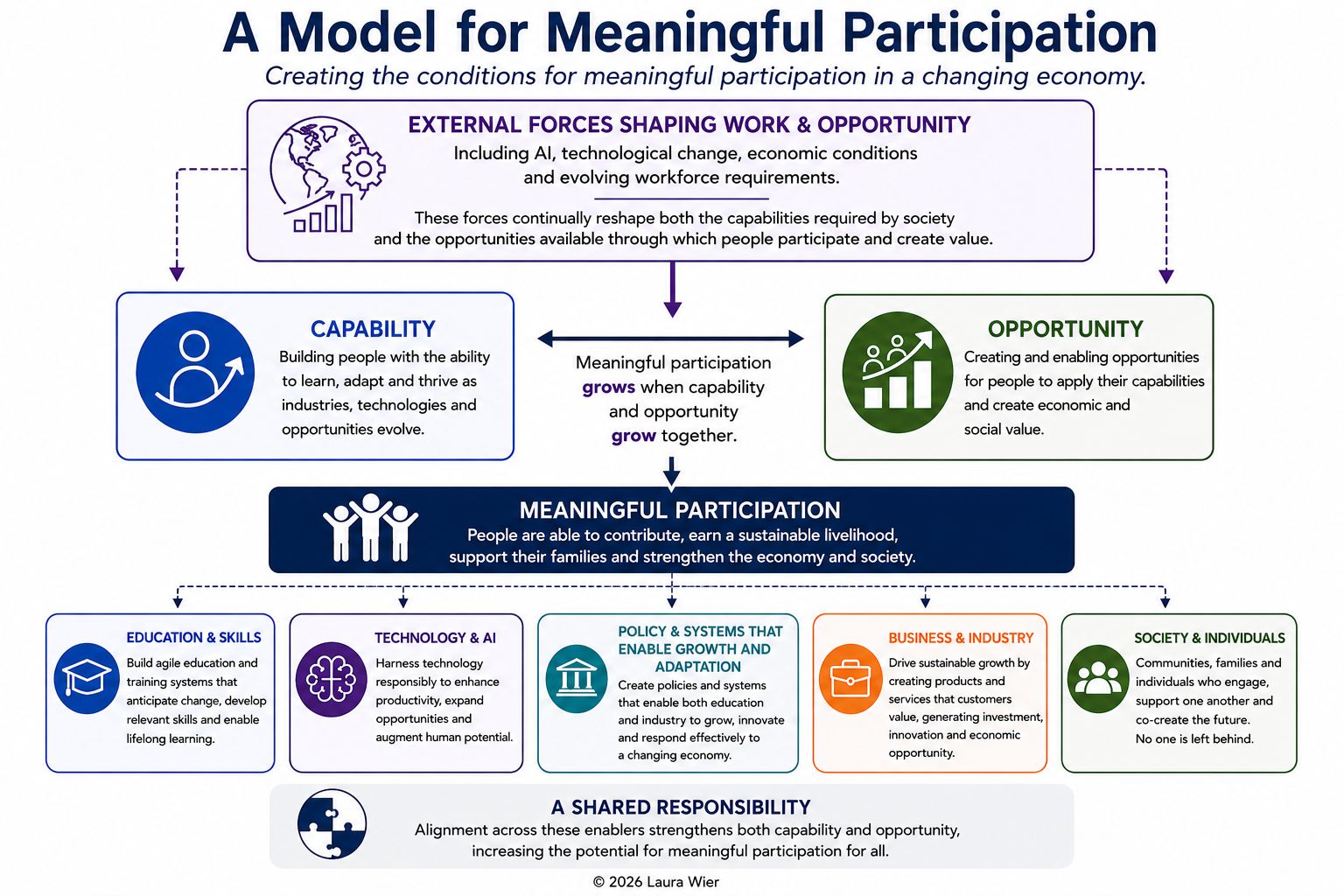

Creating the conditions for meaningful participation in a changing economy
For most of my career, I have worked in environments where capability had to translate into something practical.
In technology, consulting and business analysis, it was never enough for people to simply know things. The real question was whether they could apply that knowledge in a way that solved problems, improved systems, supported decisions and helped organisations move forward.
For many years, part of my work involved hiring, developing and mentoring business analysts. That experience shaped the way I think about capability. I saw how important technical skill is, but I also saw that skill on its own is not enough.
People need context. They need exposure. They need opportunity. They need environments where they can practise, grow, make sense of complexity and build the confidence to contribute.
Perhaps the most important lesson my career has taught me is that people are rarely the problem. More often, it is the system within which they are working. When the parts of a system are not aligned around a shared outcome, even well-intentioned effort can struggle to produce the results everyone is working so hard to achieve.
More recently, working in education has given me a different view of the same challenge.
At scale, the question is no longer simply whether individuals are developing capability. It becomes whether the capabilities we develop remain aligned to the opportunities people will ultimately need in order to participate meaningfully in the economy.
That is the tension I find myself sitting with.
For many years, South Africa has pursued two important national priorities.
The first is expanding educational opportunities. More people seek access to education than there are places available to accommodate them.
The second is expanding economic opportunity. More people seek meaningful participation in the economy than there are opportunities available to support it.
Both are important. Both deserve continued attention.
My concern is not that we are investing in education. We absolutely should. My question is whether we are applying an equivalent level of focus, urgency and innovation to expanding economic opportunity so that educational opportunity and economic opportunity continue to grow together.
I also do not believe the issue is that people are not trying. Across government, education, business and industry there are many committed people working to improve outcomes.
This is where the real alignment challenge begins.
It is a space characterised by complexity, interdependence and continual change. Education, employers, economic growth, technological advancement and public policy do not operate independently of one another. They continually influence one another, requiring continual alignment if they are to deliver the outcome we collectively seek.
This is the space between learning and earning. Between qualification and meaningful participation. Between the capabilities people are developing and the opportunities they will ultimately need in order to apply them.
It is within this complexity that our collective efforts either become aligned around a shared outcome or unintentionally drift apart.
Perhaps the challenge is not choosing between education and opportunity, but ensuring that both continue to grow together.
That, in turn, requires the capabilities being developed to remain aligned with the opportunities being created, particularly in a world where technology, industries and economic priorities continue to evolve.
If we develop more capable people, but are not creating sufficient opportunities through which they can apply those capabilities, have we solved the problem?
And if technological and economic change continues to accelerate, how do we ensure that future generations develop not only the capabilities required for today’s opportunities, but also the ability to adapt as jobs, industries and technologies evolve over time?
This question feels particularly relevant in the context of artificial intelligence.
As organisations adapt to remain competitive, the nature of work itself will change. Artificial intelligence may alter tasks, reshape roles and affect the traditional pathways through which people gain experience and enter the workforce.
Many people develop capability through participation in the workforce itself. They learn by doing. They build judgement through exposure. They develop confidence through experience.
If AI changes the nature of entry-level work, automates certain tasks or alters traditional career pathways, then creating opportunities for people to gain experience may become an even more important challenge.
The question is not whether AI will create or eliminate jobs.
The question is whether we are paying sufficient attention to how people will develop capability and enter a changing workforce if traditional pathways begin to shift.
Ultimately, meaningful participation depends on both capability and opportunity.
Education plays a critical role in developing capability. Businesses, investment, entrepreneurship and economic growth help create opportunity. Neither achieves the outcome we seek in isolation.
In a country with such high unemployment, expanding opportunity cannot be treated as secondary to expanding capability; both need deliberate and sustained attention.
The challenge, therefore, is not choosing between the two. It is ensuring they continue to grow together in a rapidly changing world.
I do not ask these questions as a criticism of the government, educational institutions or business. Each is attempting to address legitimate challenges within its sphere of influence.
Rather, I ask them because the outcome we seek is shared.
Surely our collective ambition is not simply to produce more qualifications, launch more initiatives or implement more policies.
Our collective ambition is to create a South Africa in which more people can build sustainable livelihoods, support their families, contribute to their communities and participate meaningfully in a competitive and growing economy.
If that is the outcome we seek, then perhaps the most important challenge is ensuring that we remain focused on both sides of the equation: developing adaptable capabilities and creating the opportunities through which those capabilities can be applied.
Perhaps the question is not what each stakeholder should do independently, but how we align our efforts more effectively around that shared outcome.
I do not claim to know the answer.
What I do believe is that challenges as interconnected as education, employment, economic growth and technological change are unlikely to be solved by focusing on only one dimension of the problem.
Over the course of my career, I have come to believe that meaningful outcomes are rarely achieved by improving individual parts of a system in isolation. They emerge when complex, interconnected systems remain sufficiently aligned around a shared purpose, even as the environment around them continues to change.
I do not claim to understand the full complexity of the policies, economic forces and societal factors that shape these outcomes.
What I can observe is that every part of the system appears to be working hard to improve the outcome from its own perspective.
My question is whether we are paying enough attention to how those efforts remain aligned around the outcome we collectively seek.
Because perhaps the challenge is not simply improving education, growing the economy, embracing AI or creating jobs.
Perhaps the challenge is continually aligning them.
That is the conversation I hope we continue, because meaningful participation will depend on how well we align capability, opportunity and growth in a changing economy.